
Rivers in the Life of Rāma: A Geographical and Cultural Study of Fluvial Symbolism in the Vālmīki Rāmāyaṇa
Abstract
Description
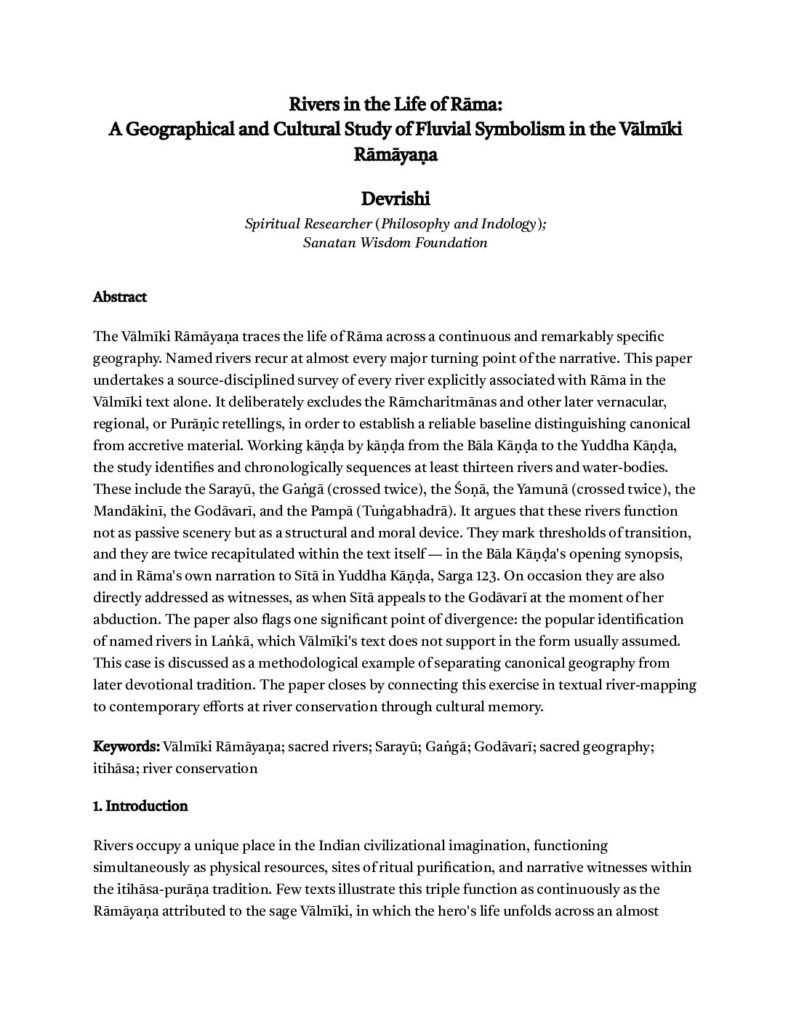
The Vālmīki Rāmāyaṇa traces the life of Rāma across a continuous and remarkably specific geography. Named rivers recur at almost every major turning point of the narrative. This paper undertakes a source-disciplined survey of every river explicitly associated with Rāma in the Vālmīki text alone. It deliberately excludes the Rāmcharitmānas and other later vernacular, regional, or Purāṇic retellings, in order to establish a reliable baseline distinguishing canonical from accretive material. Working kāṇḍa by kāṇḍa from the Bāla Kāṇḍa to the Yuddha Kāṇḍa, the study identifies and chronologically sequences at least thirteen rivers and water-bodies. These include the Sarayū, the Gaṅgā (crossed twice), the Śoṇā, the Yamunā (crossed twice), the Mandākinī, the Godāvarī, and the Pampā (Tuṅgabhadrā). It argues that these rivers function not as passive scenery but as a structural and moral device. They mark thresholds of transition, and they are twice recapitulated within the text itself — in the Bāla Kāṇḍa’s opening synopsis, and in Rāma’s own narration to Sītā in Yuddha Kāṇḍa, Sarga 123. On occasion they are also directly addressed as witnesses, as when Sītā appeals to the Godāvarī at the moment of her abduction. The paper also flags one significant point of divergence: the popular identification of named rivers in Laṅkā, which Vālmīki’s text does not support in the form usually assumed. This case is discussed as a methodological example of separating canonical geography from later devotional tradition. The paper closes by connecting this exercise in textual river-mapping to contemporary efforts at river conservation through cultural memory.
 📖 Click karein - poora paper padhein
Read Full Paper
📖 Click karein - poora paper padhein
Read Full Paper
About the Author
Cite this paper
Devrishi (2026). Rivers in the Life of Rāma: A Geographical and Cultural Study of Fluvial Symbolism in the Vālmīki Rāmāyaṇa. Sanatan Wisdom Research Papers, 2026/01, 11.