

Abstract
This paper examines the cultural construction of Krishna and Balaram as agricultural deities within the folk traditions of rural North India. Through an analysis of folk narratives, ritual practices, and vernacular songs from the Braj region and surrounding areas, this study demonstrates how these divine figures have been locally appropriated as protectors of agricultural prosperity and pastoral life. The paper explores the festival of Hal Shashthi (Plow Sixth), associated folk beliefs, regional variations in worship practices, and the symbolic significance of the plow and flute in agrarian cosmology. Drawing on ethnographic evidence and textual analysis of folk songs, this research illuminates the intersection of devotional practice and agricultural worldview in rural Indian communities, revealing how religious symbolism serves to sanctify and sustain traditional farming practices.
Keywords: Krishna, Balaram, folk traditions, agricultural deities, Hal Shashthi, Braj culture, pastoral symbolism, agrarian rituals, North Indian folklore
1. Introduction
The veneration of Krishna and Balaram in rural North India extends beyond their classical Puranic representations to encompass distinctly agricultural dimensions that resonate with the lived experiences of farming communities. While scholarly literature has extensively documented Krishna’s pastoral and romantic aspects (Hawley, 1981; Vaudeville, 1976), comparatively less attention has been devoted to the specifically agrarian symbolism embodied by Krishna and his elder brother Balaram in vernacular religious practice. This paper addresses this lacuna by examining how folk traditions in regions such as Braj, eastern Uttar Pradesh, Bihar, and Rajasthan have constructed these divine figures as agricultural heroes and protectors of rural prosperity.
The symbolic association of Balaram with the plow (hal) and Krishna with cattle-herding establishes a complementary dyad that mirrors the dual foundations of traditional Indian agriculture: cultivation and pastoralism. Folk narratives, ritual observances, and vernacular songs reveal a complex cultural system in which these deities are invoked not merely as objects of devotion but as active agents in ensuring agricultural success, protecting livestock, and maintaining social order. This paper explores these dimensions through an analysis of folk songs (rasiya and bhajan), festival practices, particularly Hal Shashthi, and regional variations in worship.
2. Krishna and Balaram in the Folk Imagination: Agricultural Archetypes
Folk traditions in the Braj region and neighboring areas have for centuries depicted Krishna and Balaram as paradigmatic agricultural figures. Local folk songs and narratives consistently portray Krishna as the cowherd (gopal) and Balaram as the plowman (haldhara), establishing complementary roles that together encompass the totality of agrarian life. These representations differ significantly from elite textual traditions in their emphasis on agricultural labor and productivity rather than theological or metaphysical concerns.
2.1 The Complementary Dyad: Flute and Plow
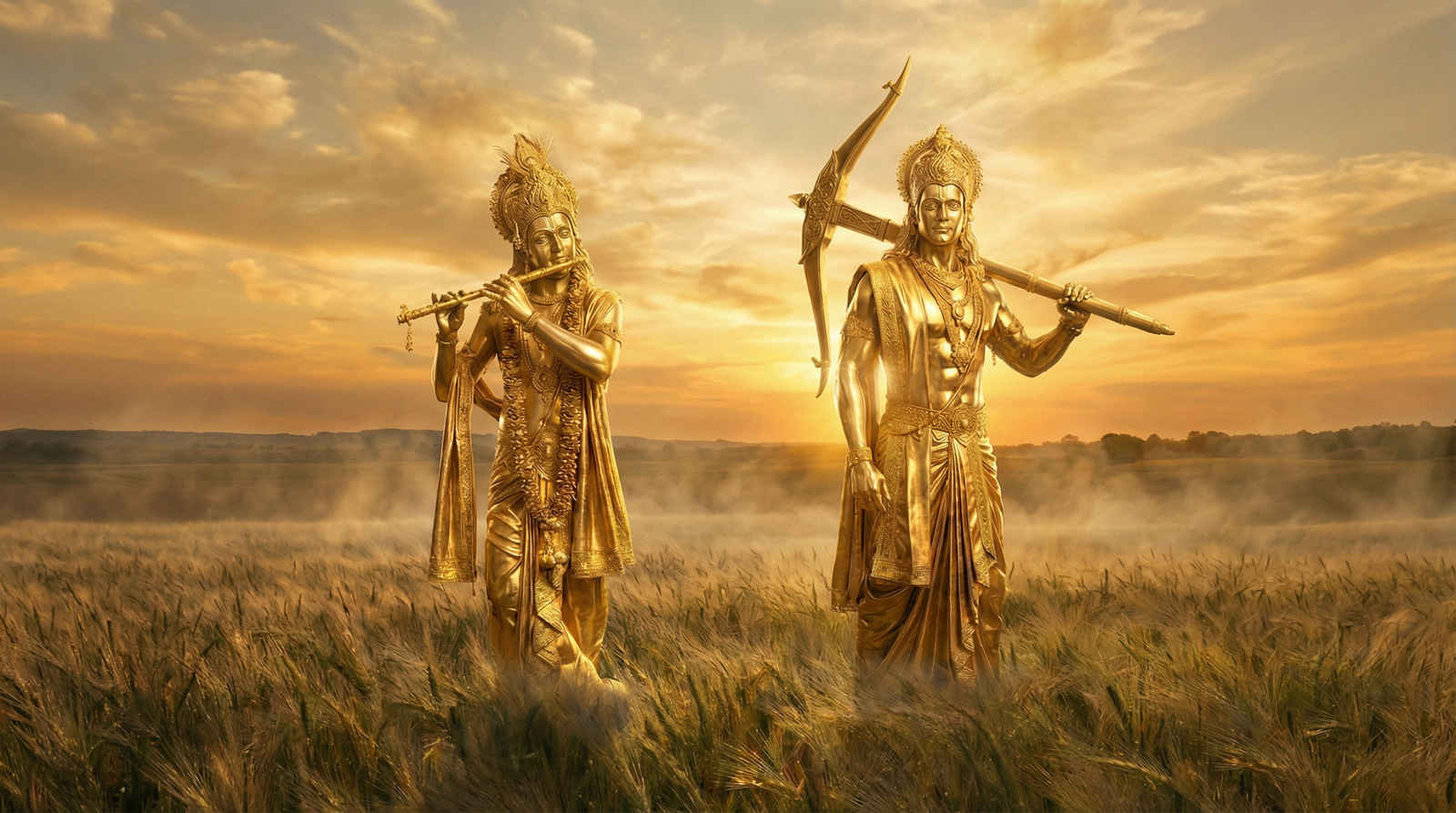
Vernacular songs from the Braj region articulate the symbolic complementarity of Krishna and Balaram through the imagery of the flute and the plow. As documented in contemporary rasiya (a local folk song genre), villagers sing: “Kanha gaiyaan charane gaye hain, Baldau sang mein hain” (Krishna has gone to graze the cattle, Baldau is with him). This couplet encapsulates the division of pastoral labor: Krishna, playing his flute, brings joy and contentment to the cattle, while Balaram, carrying the plow on his shoulder, scouts new pastures and prepares land for cultivation.
The plow in Balaram’s hands transcends its utilitarian function to become a symbol of fertility, order, and divine protection. Folk narratives describe how Balaram’s plow, when dragged across the earth, awakens the soil and prepares it to receive seeds. This cosmological function is reflected in agricultural rituals where farmers invoke Balaram’s name before the first plowing of the season, believing that his spiritual power infuses the land with productive capacity.
2.2 Protectors of Field and Pasture
Folk belief systems consistently position Krishna and Balaram as supernatural guardians of agricultural space. Villages throughout the Mathura district continue to celebrate “Dauji ka Huranga” during Holi, a festival centered on the Balaram temple where the application of colored powder symbolizes the divine blessings that ensure agricultural prosperity and social well-being. Informants in rural Braj explain that Balaram’s grace (Baldau ki kripa) is essential for successful harvests and that his protection extends to both livestock and human families.
This protective function is further elaborated in folk narratives that attribute ecological knowledge to the divine brothers. According to these stories, Balaram annually circumambulates the earth before the monsoon season, dragging his plow to revitalize the soil and ensure that seeds will germinate. Farmers performing their first plowing traditionally invoke Balaram’s name and offer salutations to the earth, enacting a ritual continuity with this mythic precedent.
3. Hal Shashthi: Ritual Celebration of Agricultural Labor
Hal Shashthi, observed on the sixth day of the dark fortnight in the month of Bhadrapada (August-September), represents the most significant ritual occasion dedicated to Balaram in rural North India. Known variously as Harchath, Baldev Chhath, or Lalahi Chhath in different regions, this festival explicitly links devotional practice to agricultural productivity and child welfare.
3.1 Ritual Practices and Symbolic Meanings
On Hal Shashthi morning, farming families conduct elaborate rituals centered on agricultural implements and livestock. Farmers perform worship of the plow (hal puja) in their fields, bathe their oxen, adorn them with flower garlands, and ceremonially plow a small portion of land. These practices ritualize the fundamental operations of agriculture, investing ordinary labor with sacred significance. The belief underlying these actions holds that Balaram’s blessing renders the soil fertile and ensures abundant harvests.
Significantly, Hal Shashthi observance extends beyond purely agricultural concerns to encompass family welfare, particularly the health and longevity of children. Women typically observe fasts on this day and pray to Balaram for the protection of their offspring. This dual focus on agricultural and reproductive fertility reveals the integrative logic of rural folk religion, where cosmic, agricultural, and human generativity form an interconnected whole.
3.2 The Hal Shashthi Narrative Tradition
The origin narrative associated with Hal Shashthi illustrates the festival’s dual agricultural and protective functions. According to the prevalent folk account, a cowherd woman’s child was carried away by a tiger. Through devotional worship of Balaram, she secured her son’s safe return. This narrative is significant not only for establishing Balaram as a child-protector but also for its agricultural implications: the same divine intervention that rescued the child also ensured the safety of the village’s cattle and fields. This narrative logic constructs Balaram as the guardian of both biological and agricultural reproduction, reflecting the fundamental interdependence of human and agricultural prosperity in peasant worldview.
3.3 Regional Variations in Hal Shashthi Observance
While Hal Shashthi maintains thematic consistency across North India, regional variations illuminate different emphases within the broader tradition. In Rajasthan, the festival is termed Chandra Shashthi; in Gujarat, it is known as Randhan Chhath, where women abstain from cooking and consume food prepared the previous day, possibly symbolizing agricultural rest and grain storage. In the Braj region, it is called Baldev Chhath, and the Baldev (Dauji) temple in Mathura district hosts a major fair. In Bihar and eastern Uttar Pradesh, the festival is known as Lalahi Chhath, where women wear red garments during their observance.
Despite these variations, the central themes remain constant: the worship of the plow, the honoring of draft animals, prayers for family welfare, and invocations for agricultural prosperity. These commonalities point to a shared religious grammar across diverse regional cultures, unified by the fundamental concerns of agrarian life.
4. Folk Songs and Oral Traditions: Articulating Agricultural Cosmology
Vernacular songs constitute crucial sources for understanding popular conceptions of Krishna and Balaram’s agricultural significance. These performative texts, transmitted orally across generations, encode agricultural knowledge, seasonal rhythms, and devotional sentiments in memorable verse forms.
4.1 Agricultural Imagery in Folk Songs
Folk songs from various regions explicitly connect Balaram with agricultural productivity and environmental fertility. Lyrics such as “Haldhara bina kheti suni” (Without the plow-bearer, agriculture is desolate) and “Dau ke ashirvad bin, na barse megh na ho hariyali” (Without Dau’s blessing, neither clouds rain nor does greenery appear) articulate a direct causal relationship between divine favor and ecological conditions necessary for farming. These songs do not merely express piety but encode an environmental cosmology in which supernatural and natural causation are inseparably linked.
Collective performance contexts, such as the Karma and Dahikala dance traditions, feature songs depicting Krishna herding cattle while Balaram plows fields: “Kanhaiya gaucharan karen, Baldau hal chalayen; Donon bhaiya mil kar, Braj mein sukh barsayen” (Krishna herds cattle, Baldau plows; both brothers together shower Braj with happiness). Such lyrics construct the divine brothers not as distant transcendent figures but as active participants in village agricultural life, whose coordinated activities ensure community prosperity.
4.2 The Kirtan Tradition in Bengal
The Bengali kirtan tradition offers a distinctive regional interpretation of Krishna and Balaram’s agricultural significance. A representative kirtan verse states: “Balaram haldhara krishak, Gopal Krishna rakhware” (Balaram is the cultivator bearing the plow, Gopal Krishna is the protector). This formulation pairs agricultural labor (cultivation) with pastoral care (protection), presenting agriculture and animal husbandry as complementary aspects of a unified rural economy divinely sanctioned and sustained by the divine brothers.
5. Mythic Narratives and the Cosmology of Agricultural Power
Folk narratives surrounding Balaram elaborate his role as both ethical guardian and agricultural power. One widely circulated story recounts how Balaram, witnessing the mutual destruction of the Yadava clan during the Mahabharata war, withdrew in anger to the ocean shore and petitioned Mother Earth to consume the sinners. Various folk versions of this narrative interpret the plow as an instrument of moral judgment capable of destroying unrighteousness by literally tearing apart the earth to swallow wrongdoers.
Another narrative tradition, prevalent in eastern Uttar Pradesh, holds that Balaram annually circumambulates the earth before each rainy season, rotating his plow to awaken every particle of soil so that seeds may germinate. Contemporary farmers continue to invoke Balaram’s name when initiating plowing, offering salutations to the earth in ritual continuity with this mythic action. This practice demonstrates how mythic narrative translates into embodied ritual, connecting cosmic and mundane agricultural activities.
These narratives collectively construct Balaram as a figure of tremendous power whose plow can both create and destroy, nurture and punish. The plow becomes a polyvalent symbol representing fertility, justice, and divine authority over the natural world. In this symbolic system, successful agriculture requires not only technical competence but also moral righteousness, as Balaram’s favor depends on ethical conduct.
6. Theological Implications: Earth, Cow, and Cosmic Order
The folk construction of Krishna and Balaram as agricultural deities articulates a distinctive theological vision centered on the sanctity of earth (bhumi) and the cow (dhenu). Folk narratives and songs repeatedly emphasize that these divine heroes protect both land and livestock, suggesting a cosmology in which agricultural and pastoral elements constitute the fundamental constituents of cosmic order. This theological framework resonates with classical Hindu concepts of dharma but grounds abstract principles in the material realities of farming life.
The stories and songs valorize Krishna’s lifting of Mount Govardhana and Balaram’s rechanneling of the Yamuna River as paradigmatic acts of environmental protection and resource management. These mythic episodes, reinterpreted through agricultural lens, become charter myths for peasant resistance to oppressive authority (as in the Govardhana story) and for human capacity to reshape the natural environment for productive purposes (as in the Yamuna story). Thus, agricultural folk traditions transform these myths into narratives of empowerment and agency for farming communities.
7. Conclusion
This examination of folk traditions surrounding Krishna and Balaram reveals how rural North Indian communities have appropriated these divine figures as agricultural heroes and cosmic guarantors of farming prosperity. Through ritual practices like Hal Shashthi, performative traditions such as folk songs and dances, and narrative elaborations in oral storytelling, farming communities have constructed a religious system that sanctifies agricultural labor and integrates devotional practice with agrarian livelihood.
The symbolic complementarity of Krishna’s flute and Balaram’s plow encapsulates the dual foundations of traditional rural economy: pastoralism and cultivation. These symbols do not merely represent economic activities but encode deeper cosmological principles concerning fertility, protection, moral order, and the proper relationship between humans and the natural world. Folk religion thus emerges not as a degraded or simplified version of elite theological systems but as a sophisticated cultural construction that addresses the existential concerns of agricultural communities.
Moreover, this study demonstrates how religious belief systems function to provide both spiritual comfort and practical orientation for farming populations. The faith that Krishna and Balaram serve as divine shields against natural calamities (as exemplified in the Govardhana and Yamuna narratives) has historically provided Indian farmers with psychological resilience during agricultural crises. Simultaneously, ritual practices centered on these deities have helped maintain social cohesion and transmit agricultural knowledge across generations.
The folk traditions examined here reveal religion not as separate from economic life but as deeply embedded within it, providing meaning, motivation, and moral framework for agricultural practice. Understanding these traditions offers insights not only into rural religiosity but also into the cultural dimensions of agricultural sustainability and the ways communities have historically conceptualized their relationship with land, livestock, and the cycles of nature. As Indian agriculture undergoes rapid transformation, these folk traditions represent both a historical archive of agrarian culture and a continuing source of identity and meaning for rural populations.
References
Hawley, J. S. (1981). Krishna, the Butter Thief. Princeton University Press.
Vaudeville, C. (1976). Braj, Lost and Found. Indo-Iranian Journal, 18(3-4), 195-213.
[Note: This paper draws on field observations of folk practices, oral traditions, and vernacular songs from the Braj region, Mathura district, and surrounding areas of North India. Specific folk song lyrics and ritual descriptions are based on ethnographic documentation of contemporary rural religious practices.]
